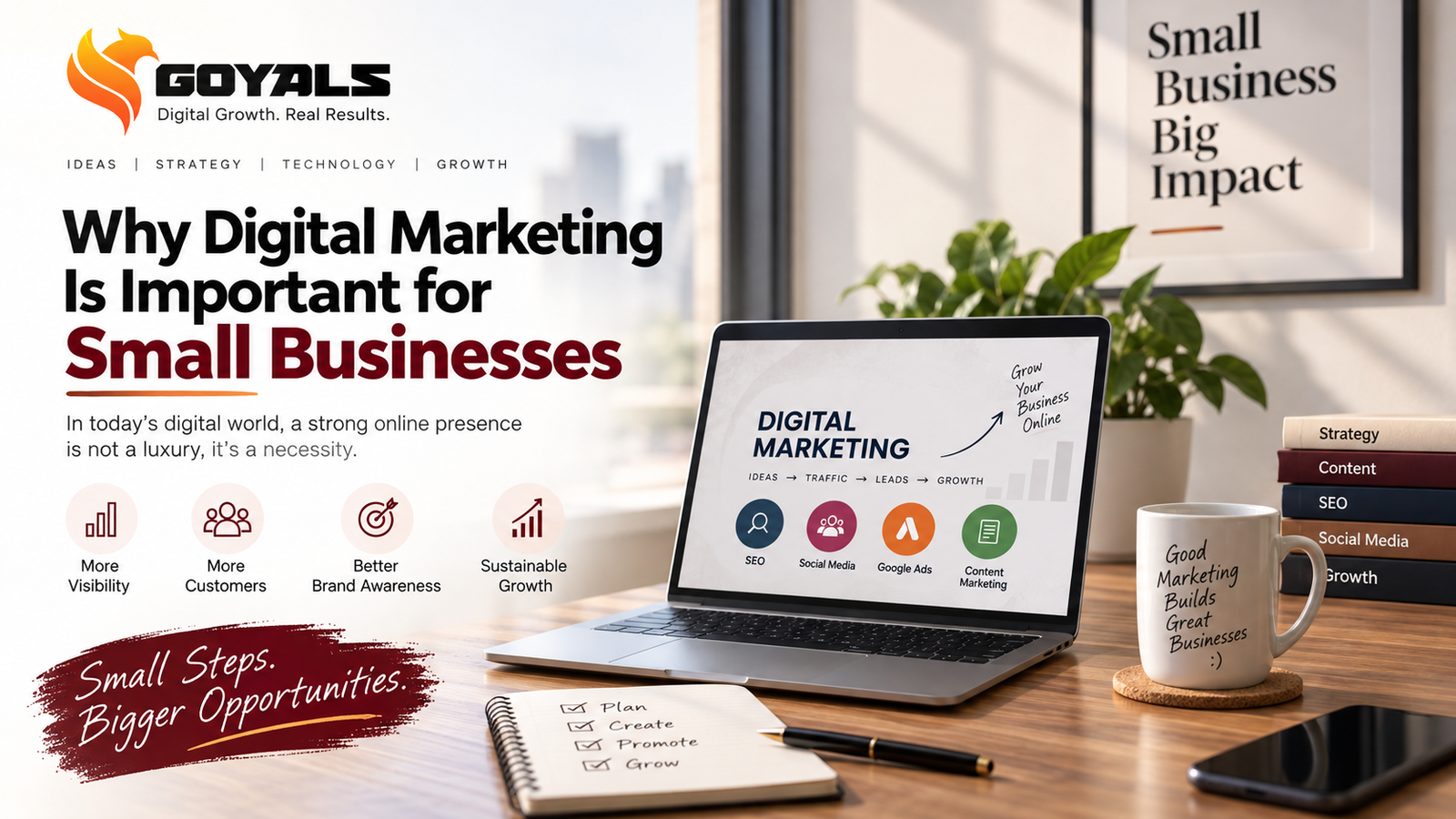
Why Digital Marketing Is Important for Small Businesses
Running a small business is not easy. You may have a great product, provide reliable services and have years of experience, but getting your business in front of the right customers can still be a challenge.
This is where digital marketing for small businesses becomes important.
Today, customers often search online before deciding where to buy, which service provider to contact or which company to trust. They may search on Google, check a company's website, look at social media profiles, read reviews or compare different businesses before making a decision.
For a small business, having a strong online presence can help make your brand easier to discover and give potential customers more reasons to choose you.
Digital marketing also allows businesses to start with specific goals, test different channels and measure what is generating traffic, enquiries or sales. SEO, social media, content marketing, email marketing and paid advertising can all play different roles depending on the business and its audience.
In this guide, we will explain why digital marketing is important for small businesses, the major benefits it can provide and how a small business can build a practical online marketing strategy.
What Is Digital Marketing?
Digital marketing is the process of promoting a business, product or service through online channels.
These channels can include:
- Search engines such as Google
- Business websites
- Social media platforms
- Online advertising
- Email marketing
- Content marketing
- Video marketing
- Local SEO
- Google Business Profile
- WhatsApp and other digital communication channels
The objective is not simply to get more website visitors. A good digital marketing strategy should help a business attract relevant people, build trust and turn interested visitors into enquiries, customers or repeat buyers.
For example, a local furniture store may use SEO to appear when people search for furniture in its city, while an online clothing brand may use Instagram, Google Ads and content marketing to reach customers across different locations.
The right approach depends on the business, target audience, industry and goals.
Why Is Digital Marketing Important for Small Businesses?
Small businesses often have limited marketing budgets compared with large companies. This makes it important to spend marketing resources carefully.
Digital marketing provides several ways to reach a specific audience, build visibility and measure performance.
Here are some of the major reasons digital marketing matters for small businesses.
1. Helps Your Business Get Found Online
One of the biggest advantages of digital marketing is improved online visibility.
When people need a product or service, they often search online before contacting a business. If your website or business profile does not appear when potential customers are searching, they may never discover your brand.
Search engine optimization can help your website target relevant search queries and improve its visibility in organic search results.
For example, instead of simply targeting a broad term such as "furniture", a local furniture business could create useful content and pages around searches related to its products, services and location.
The goal is to appear where your potential customers are already looking.
2. Helps You Reach the Right Audience
Traditional advertising can sometimes put your message in front of a very broad audience.
Digital marketing gives businesses more options for reaching specific audiences.
Depending on the platform, businesses can target people based on factors such as:
- Location
- Search behaviour
- Interests
- Demographics
- Previous website interactions
- Content engagement
- Customer behaviour
For a small business, reaching a relevant audience can be more useful than simply reaching a large number of people.
A local restaurant, for example, does not necessarily need to advertise to people across the entire country. It may benefit more from reaching people searching for restaurants within its service area.
3. Builds a Strong Online Presence
Your website is often one of the first places where potential customers learn about your business.
A strong online presence can include:
- A professional website
- Search engine visibility
- Active social media profiles
- Useful blog content
- Customer reviews
- A complete Google Business Profile
- Consistent business information across online platforms
When these elements work together, customers can find information about your business at different stages of their buying journey.
Someone may discover your brand through Google, visit your website, check your Instagram profile and then contact you through WhatsApp.
Digital marketing helps connect these different touchpoints.
4. Helps Generate More Qualified Leads
Getting website traffic is useful, but traffic alone does not necessarily generate business.
The real objective is to attract people who have a genuine interest in your products or services.
This is where lead generation digital marketing becomes important.
For example, a service business can use:
- SEO
- Google Ads
- Landing pages
- Social media marketing
- Content marketing
- Lead forms
- WhatsApp campaigns
to encourage potential customers to make an enquiry.
A good strategy focuses not only on increasing traffic but also on improving the quality of that traffic.
5. Gives Small Businesses the Opportunity to Compete Online
Large companies may have bigger advertising budgets, but online visibility is not determined by advertising budget alone.
Relevance, useful content, customer experience, local visibility and a well-optimized website can all contribute to how a business performs online.
A small business can focus on a specific niche, location or customer problem instead of trying to compete for every possible search.
For example, instead of trying to target every search related to "digital marketing", a small agency could create useful content around topics such as:
digital marketing for small businesses
or
digital marketing strategy for local businesses
This type of focused approach can help a business build relevance around a particular audience.
6. Digital Marketing Can Be Measured
One of the biggest differences between digital marketing and many traditional marketing methods is the amount of performance data available.
Businesses can use tools such as Google Analytics and Google Search Console to understand website performance and search visibility.
Depending on the campaign, businesses can monitor metrics such as:
- Website traffic
- Search impressions
- Clicks
- Leads
- Conversion rate
- Cost per lead
- Engagement
- Ad performance
- Landing page performance
This information can help businesses identify which activities are working and where improvements are needed.
Instead of continuing with a marketing activity simply because it has always been done, businesses can use data to make better decisions.
7. SEO Can Provide Long-Term Visibility
Search engine optimization is an important part of a long-term digital marketing strategy.
SEO involves improving different aspects of a website so that search engines can better understand its content and users can find useful information more easily.
For small businesses, SEO can be particularly useful because a well-optimized page can continue attracting organic visitors after it has been published.
A practical SEO strategy can include:
- Keyword research
- Helpful website content
- On-page SEO
- Technical SEO
- Internal linking
- Local SEO
- Content marketing
- Image optimization
- Website performance improvements
SEO generally requires consistency rather than expecting immediate results from a single optimization.
8. Social Media Helps Build Customer Relationships
Social media is not only a platform for posting promotional content.
For small businesses, it can be a way to show the people behind the brand, answer customer questions, showcase products and share useful information.
Businesses can use platforms such as Instagram, Facebook, LinkedIn and YouTube depending on where their audience spends time.
A social media strategy can include:
- Educational posts
- Product demonstrations
- Customer stories
- Behind-the-scenes content
- Short-form videos
- FAQs
- Industry tips
- Offers and promotions
The goal should be to provide content that is useful and relevant to the audience rather than constantly promoting products.
9. Local SEO Can Help Attract Nearby Customers
For businesses that serve a particular city or region, local SEO can be an important part of digital marketing.
Imagine someone searching:
"digital marketing agency near me"
or
"digital marketing company in Jaipur"
A business that has properly optimized its website and local presence has a better opportunity to appear for relevant local searches.
Local SEO can involve:
- Google Business Profile optimization
- Local keyword targeting
- Location-specific website content
- Customer reviews
- Local citations
- Consistent business information
- Local landing pages
For businesses serving customers in Jaipur, for example, creating genuinely useful Jaipur-focused content can help establish local relevance without unnecessarily repeating location keywords throughout every page.
10. Digital Marketing Helps Build Brand Trust
Customers want to know whether a business is reliable before spending their money.
A professional website, useful content, genuine customer reviews, active social media profiles and clear business information can all contribute to the overall impression of a brand.
Content is particularly useful for demonstrating knowledge.
Suppose someone is looking for a service and finds a detailed article that answers their questions. That person may become more familiar with the business before making an enquiry.
This is one reason content marketing and SEO can work together as part of a broader digital marketing strategy.
11. You Can Start With a Small Budget
Digital marketing does not necessarily mean starting every possible channel at once.
A small business can begin with the areas that are most relevant to its goals.
For example:
Goal: Organic traffic
Focus on SEO and content marketing.
Goal: Local customers
Focus on local SEO and Google Business Profile.
Goal: Quick lead generation
Consider Google Ads or social media advertising.
Goal: Brand awareness
Focus on social media and useful content.
The important thing is to start with a clear objective and measure performance before expanding the strategy.
12. Digital Marketing Supports Business Growth
Digital marketing can support different stages of the customer journey.
A potential customer may first discover a business through Google.
They may then read a blog article, visit the website, check reviews and follow the business on social media.
Later, they may contact the business or make a purchase.
This means digital marketing should not be viewed as one single activity.
SEO, content, social media, paid advertising, email marketing and conversion optimization can work together to create a more complete customer journey.
How to Create a Digital Marketing Strategy for a Small Business
A small business does not need a complicated marketing plan to get started.
A simple approach can be:
Step 1: Define Your Target Customer
Understand who you want to reach.
Consider:
- Who are your customers?
- Where are they located?
- What problems do they have?
- What products or services do they need?
- What questions do they search online?
Step 2: Set a Clear Goal
Your goal could be:
- More enquiries
- More phone calls
- More website traffic
- More online sales
- More local customers
- Better Google visibility
- Increased brand awareness
Step 3: Research Relevant Keywords
Keyword research can help identify what potential customers are searching for.
Instead of targeting only broad keywords, consider specific long-tail searches that match your products, services and locations.
Step 4: Optimize Your Website
Your website should clearly explain:
- What your business does
- What products or services you offer
- Who you serve
- Where you operate
- How customers can contact you
Your important pages should also have appropriate titles, headings, descriptions and internal links.
Step 5: Create Useful Content
Publish content that answers genuine customer questions.
For example, a digital marketing agency can publish guides about SEO, Google Ads, social media marketing, content marketing and online lead generation.
Step 6: Promote Your Content
Share useful articles through social media, email and other relevant channels.
Step 7: Track the Results
Review your traffic, rankings, enquiries, conversions and campaign performance regularly.
Then improve the strategy based on actual data.
Common Digital Marketing Mistakes Small Businesses Should Avoid
Digital marketing can be effective, but businesses should avoid treating it as a shortcut.
Some common mistakes include:
Targeting Too Many Keywords
Trying to rank for hundreds of unrelated keywords can make your website unfocused.
Publishing Content Without a Strategy
Every article should have a clear topic, search intent and purpose.
Focusing Only on Social Media
Social media is useful, but your website, SEO and other channels can also play an important role.
Ignoring Local SEO
If your business serves a specific city, local search visibility should be part of your strategy.
Buying Fake Followers or Backlinks
Artificial numbers do not replace genuine customers, useful content or authoritative links.
Not Tracking Results
Without measuring performance, it becomes difficult to understand what is actually contributing to business growth.
Final Thoughts
Digital marketing has become an important part of how small businesses reach and communicate with customers.
From SEO and local search to social media, content marketing and online advertising, businesses have multiple ways to build visibility and attract potential customers.
The key is not to use every digital marketing channel at the same time. Instead, identify your target audience, set clear goals, choose the channels that match those goals and consistently improve your strategy using real performance data.
For a small business, a well-planned digital marketing strategy can help create a stronger online presence, generate relevant enquiries and build long-term visibility.
If you are looking for professional support with SEO, social media marketing, Google Ads, website development, content marketing or other digital marketing services, Goyals Technologies can help you create a strategy based on your business goals and target audience.
Frequently Asked Questions
Why is digital marketing important for small businesses?
Digital marketing helps small businesses improve online visibility, reach relevant customers, generate enquiries and measure marketing performance. It can also help businesses build their brand and compete within specific markets or locations.
What is the best digital marketing strategy for a small business?
There is no single strategy that works for every business. SEO, local SEO, social media, content marketing and paid advertising can all be useful, but the right combination depends on the business goals, audience, industry and budget.
How can small businesses use digital marketing?
Small businesses can use digital marketing through SEO, social media marketing, content marketing, Google Ads, local SEO, email marketing, websites and other online channels.
Is SEO useful for small businesses?
Yes. SEO can help small businesses improve their visibility for relevant search queries and attract organic website traffic over time. The strategy should focus on useful content, relevant keywords, technical website health and search intent.
Can digital marketing help a local business?
Yes. Local SEO, Google Business Profile optimization, location-focused content, reviews and targeted advertising can help businesses reach customers in their service areas.
How much does digital marketing cost for a small business?
The cost depends on the services required, business goals, industry, competition and marketing channels being used. A business can start with a focused strategy and increase its investment as it identifies what generates results.
.jpg)